The Dormouse Hollow
Dormouse Conservation
Lithuania's Nature Reserves for Dormice:
Contribution by Dr. Rimvydas Juškaitis
©: Institute of Ecology, Akademijos
2, LT-2600 Vilnius, Lithuania
The majority of localities in Lithuania where the fat
dormouse occurs are in protected areas. Three zoological reserves were
established for the protection of this species in Lithuania.
- Strosiunai Theriological Reserve
- Rumsiskes Theriological Reserve
- Semeniukai Zoological Reserve / Neris Regional Park
Strosiunai Theriological Reserve and Rumsiskes Theriological Reserve
In 1991 two reserves - Strosiunai theriological reserve (area
of 188 ha) and Rumsiskes theriological reserve (area of 280 ha)
- were established by local authority of Kaisiadorys district (Central
Lithuania). The aims of these reserves are to protect populations of the
fat dormouse, their habitats (mature mixed oak-woods), and animal communities
living there. Special "Rules of Forest Protection and Use" are
applied in these reserves. Both these reserves are introduced in the booklet
"Reserves for dormice".
Juškaitis R., Malinauskas V., Dementavicius D. 1997. Reserves for dormice.
Vilnius. 24 pp. (in Lithuanian).
The booklet presents the history of discovering the fat dormouse in
Lithuania in the 20th century. The biology of this species is described.
The questions why and how fat dormice have to be protected are discussed.
Another dormouse species living in both reserves, the common dormouse,
is introduced briefly.
The Strosiunai and Rumsiskes theriological reserves are described comprehensively:
forest stands of reserves, mammals, birds, amphibians and reptiles, dormouse
research, means of protection etc. Restrictions of forest use and economical
activities as well as prohibited activities in these zoological reserves
are presented.
Semeniukai Zoological Reserve / Neris Regional Park
 Neris
Regional Park was established in 1992, and it covers the environs of
the Neris river near the Vilnius town. This regional park is important
in zoological respect because it holds three localities for fat dormice
out of the eight known in Lithuania. In the Neris regional park, the Semeniukai
zoological reserve was established for the protection of fat dormice (this
species is included in the Red Data book of Lithuania).
Neris
Regional Park was established in 1992, and it covers the environs of
the Neris river near the Vilnius town. This regional park is important
in zoological respect because it holds three localities for fat dormice
out of the eight known in Lithuania. In the Neris regional park, the Semeniukai
zoological reserve was established for the protection of fat dormice (this
species is included in the Red Data book of Lithuania).
There are three localities for the fat dormouse in Neris regional park,
which covers the environs of the Neris river near the Vilnius town. Semeniukai
zoological reserve was established for the protection of fat dormice in
one of these localities.
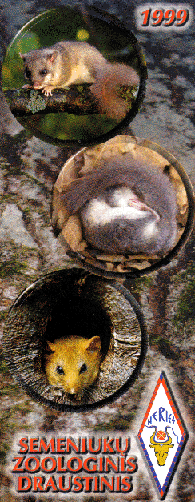
A booklet introducing to dormice in Neris regional park was published
in 1999. This booklet (in Lithuanian) introduces to dormice in Neris regional
park. The history of discovering the fat dormouse in Neris regional park
and the biology of this species are described. Another dormouse species,
living in the regional park, the common dormouse, is introduced briefly.
Necessary measures for protecting the species and forbidden activities
in the territory of the Semeniukai zoological reserve are presented.
Address:
Neris Regional Park
Dukstu g-ja, Adomtiskes Dukstu pastas
Dukstos 4047 Vilniaus rajonas
Lithuania
Tel.: (370 - 2) 599224
Contact: Dr. Rimvydas Juškaitis:
Institute of Ecology, Akademijos 2, LT-2600 Vilnius, Lithuania
Photos © Rimvydas Juškaitis